"The Buzz" from Dan Barry
Hornet's Nest Founding Member, Director and Past President
Dan Barry is an 8th-generation native of Charlotte. Raised in south Charlotte and educated in public schools until the 11th grade, Dan has been active in GOP politics since a young age. Over the past 30 years, Dan has served in numerous GOP party roles. He has served as the Union County GOP Chairman and a decades-long member of its Executive Committee.
For the NCGOP, Dan has served on both the 9th District and 8th District Executive Committees and the NCGOP Executive Committee. For nearly 10 years, Dan has served on the NGOP Plan of Organization Committee. In 2023, he was appointed by Chairman Michael Whatley to serve as the Plan of Organization Committee’s Chairman.
Dan has served in numerous campaign roles, served in public office, and ran for the 9th Congressional District seat in 2012. Dan’s tireless work for the GOP, our candidates, our elected officials, and our voters is recognized by his election to be a 2020 Republican Elector for North Carolina’s 9th District. This was followed by his election in 2024 as an Elector representing the 8th District. The 2024 Electoral College recognized his significant contributions by electing him to serve as the 2024 Electoral College President.

Conservative Principles Improve the Human Condition
by Daniel B. Barry, November 2026 [Part 1 of 3]
Principles. People. Purpose. | Conservative Principles Improve Lives.
The North Carolina Republican Party is at a crossroads. I have spent over 40 years engaged in the political debate. I have served in public office, run for federal office, and volunteered at every level of the North Carolina Republican Party. Those experiences have taught me that winning elections begins with knowing what we believe and why it matters.
For my entire public life, I have been a consistent voice for true conservatism to anyone who will listen. We stand on the shoulders of generations who defended liberty and freedom. Goldwater and Reagan gave those convictions a political voice. Thinkers such as Hayek, Buckley, Friedman, Frank Meyer and Robert Nisbet helped shape the intellectual foundation. More recently, writers such as Amity Shlaes and Matthew Continetti have examined that inheritance. The fusionist movement of the 1950s and 1960s brought classical liberalism and traditional conservatism together and helped define the modern conservative movement.
Our parents used to tell us, ‘Don’t forget where you came from.’ Unfortunately, too many Republicans have done exactly that. We have allowed personalities, factions, and the next election to crowd out the principles that brought us together. The 2026 election results should force us to examine where we have gone wrong.
We can spend the next year pointing fingers and building walls between factions. Or we can do the harder work of reminding North Carolinians what we believe, why it matters, and how it affects their daily lives.
Bottom line: Conservative principles, when enacted into sound public policy, improve lives. They change the human condition.
Modern conservatism draws from two closely related sources: classical liberalism and traditional conservatism. Classical liberalism recognizes that individuals possess rights endowed by their Creator, not granted by government. Freedom, liberty, property, freedom of conscience, and equal treatment under the law are not empty words. Our Founders placed constitutional limits on government so individuals could use their God-given talents to pursue their own dreams. The Declaration of Independence set forth our mission; the Constitution established the framework for carrying it out.
Traditional conservatism adds something essential. A free society depends on character, duty, faith, family, and institutions that endure beyond any election. Freedom and liberty require responsible citizens. The American achievement of over nearly 250 years has been holding freedom and responsibility together.
That is why I believe the family is our most important political institution. Parents have responsibilities government cannot assume. Families teach duty, character, work, and concern for others long before a child grows into adulthood. Churches, charities and civic associations strengthen the communities around them. Government has an important and unique role, but it cannot replace those bonds without weakening the very society it is supposed to serve.
Conservative principles have practical consequences. Parents, not bureaucracies, should have the primary voice in their children's education. A small business owner should have the opportunity to build something without being buried under needless rules and regulations. Wage earners should keep more of what they earn and decide for themselves how to use their resources. Churches and charities should be free to serve their neighbors without government programs crowding out local initiative or encouraging long-term dependency.
These are not abstract philosophies recited at conventions. They affect whether a child learns to read, whether a young couple can afford a home, whether a business expands and hires another worker, and whether a community can care for its own.
Conservatives should be willing to judge policy by both principle and result. I would apply a simple liberty test: Does a proposal protect individual freedom and respect constitutional limits? Does it expand opportunity, strengthen families, and improve schools? Does it produce the results promised? Passing a bill or winning an argument is not, by itself, success. It never has been.
The same standard should apply to our party. Leadership is a trust, not a title. County organizations, congressional district leaders, and state officers should set goals, manage resources honestly and report results. Our objectives are simple: to win elections by winning hearts and minds of voters. We fell short. Accountability is not disloyalty. It is what serious organizations demand of themselves.
Every disagreement is not a purity test. Grassroots activists, party officers, and Republican elected officials have different jobs, but they are not enemies. Debate over strategy is healthy. Personal feuds, keeping score, and factional warfare are not. We can disagree forcefully without forgetting that our principles matter more than any one person.
Most of all, Republicans must offer something better than a running list of grievances against Democrats. Voters deserve an affirmative account of the North Carolina we want to build: good schools, strong families, safe communities, rewarding work, honest government, and the freedom to pursue a meaningful life.
The future of the NCGOP will not be secured by a new slogan, branding campaign or set of officers alone. It depends on connecting our enduring conservative principles to the concerns of North Carolinians and then delivering on what we promise.
Conservative principles improve the human condition. Our job is to prove it.
Principles to Policy: A Conservative Agenda for Republicans
by Daniel B. Barry, November 2026 [Part 2 of 3]
Principles. People. Purpose. | Conservative Principles Improve Lives.
In my first installment, I argued that conservative principles when enacted into policy transform the human condition. They improve lives. It’s more than a claim or statement of faith in our political tradition. It’s the measuring stick against which Republicans judge every policy proposed and every promise made.
If a conservative agenda cannot explain how, it helps families, expands opportunities, and strengthens communities, we have more work to do.
I tend to lean into economic and education policies. They are ultimately connected. A growing economy requires a prepared workforce. A prepared workforce requires education. With education, the central question is not who controls the money. It is whether a child is learning and prepared for the next phase of life. Families deserve meaningful choices, transparent information and a real voice in their children’s education. School choice and strong public schools are not enemies and should coexist. Free market economists have proven that competition lowers costs and improves results and outcomes. Let’s apply that principle to education. We should expect every school receiving public support to demonstrate measurable results, especially in reading, mathematics and preparation for work or further study. A child’s ZIP code should not determine the limits of that child’s future.
A prepared and growing workforce is a necessity to remain competitive. Not all students need a four-year college degree. Apprenticeships, community colleges, technical education and employer partnerships can open doors to rewarding careers. The goal is not to steer everyone down the same path. It is to give individuals freedom and preparation to choose their own.
Next is economic opportunity. North Carolina has experienced significant economic growth, but a growing economy means little to a family priced out of housing or a young person who cannot find a path into a good career. We must protect a competitive tax climate, eliminate unnecessary regulations that impose costs without demonstrated benefits, and make it easier to start and expand a business. Growth should not be measured by investment alone, but include the ability for families to get ahead.
Families belong at the center of this agenda. Stable families are society’s greatest sources of security, responsibility and opportunity. Public policy cannot create a strong marriage or good parenting. It can, however, avoid penalizing work and marriage. Policies must respect parents’ authority, protect children and remove unnecessary barriers to building a household. When we discuss taxes, education, housing or public safety, we should ask what the decision means for families.
Fiscal discipline is a test of our seriousness and resolve. A government that promises everything eventually weakens its ability to do what only government can do well. Barry Goldwater and President Gerald Ford are credited with the much-quoted statement, “A government big enough to give you everything you want is powerful enough to take away everything you have”. Budgets should reflect priorities, not simply last year’s spending plus an increase. Government programs and projects require clear objectives, performance reviews and the willingness to change or end what does not work. Debt and deferred obligations are not free money; they are claims against tomorrow’s taxpayers – our children and grandchildren.
Government does have certain limited responsibilities. Protecting public safety, maintaining sound infrastructure, administering justice and providing essential services. Limited government does not mean incompetent government. Government and elected officials must perform these limited functions competently and maintain resolve to say no to policies outside their scope. Thus, leaving citizens and communities room to act.
Our party must practice what it preaches: accountability. We should publish understandable financial reports, establish measurable organizational goals, develop local leadership and judge political investments by results. Precinct and County officers, the backbone of the GOP, deserve respect and support, not a quick call and pat on the head when campaign season arrives. Elected officials should routinely explain how they voted on policy initiatives and what their decisions accomplished. The test is, did the decision expand liberty and freedom or did it transfer more control of our lives to the government? Did it produce the results promised.
Changing course will require debate and difficult choices. Conservatives will have different opinions, and that is healthy. But we should be able to agree on the goal: liberty under law, opportunities earned through work, strong families, responsible government and thriving communities.
Republicans cannot ask voters to trust us simply because we call ourselves conservatives. We must earn that trust with clear proposals, competent execution and visible results.
Winning elections gives us the chance to govern. Improving lives is why that chance matters.
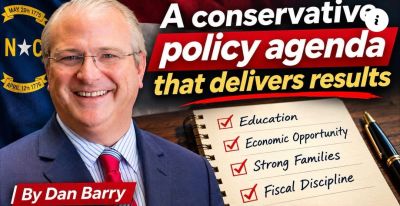
by Daniel B. Barry, November 2026 [Part 3 of 3]
Principles. People. Purpose. | Conservative Principles Improve Lives.
Political parties are not ends in themselves. They are organizations formed to advance ideas, earn the public’s trust, and elect people capable of putting principles into policy. When a party forgets its role: to win elections, it can spend more energy defending its organization than persuading the voters it hopes to serve. Winning elections provides us with the opportunity to serve and put our conservative principles to work.
After the 2026 election, the NCGOP has an opportunity and an obligation to assess the damage and consider course correction. We can make accountability a source of strength rather than a word reserved for criticizing our opponents.
Conservatives have long argued that government is limited, should live within its means, exercise authority entrusted to it, and answer to the people. Government has different responsibilities at the city, county, state, federal levels. The NCGOP is organized by Precinct, County, Congressional District, State, and RNC. Each level has a role and limited authority under its Plan of Organization. The standards we judge for the performance of government should apply just as rigorously to our own party. We cannot demand fiscal discipline in Raleigh and Washington while treating the party’s finances as someone else’s concern. We cannot call for transparency in government while treating questions from precinct and county volunteers as acts of disloyalty.
Accountability begins with the basics. Financially it begins with budgets stakeholders can understand, debts openly reported, realistic fundraising plans established, communicated, and reported along with regular measures of organizational performance. Organizationally, it means a defined strategy with clear objectives, and tactics which can be measured and reported. How many precincts are organized? Are we registering and contacting voters? Are county organizations preparing volunteers? Electorally, it means we are recruiting candidates, turning out voters, and examining results. What is working, and what isn’t. And ultimately who is responsible for fixing it?
These questions are not personal attacks. They are the questions any responsible board would ask of organizational leadership routinely. When the results don’t measure up, answers must lead to changes in strategy, resources, and when necessary, leadership. Without it, accountability is just another word in a speech.
Elections are the clearest measure of whether our message and organization are connecting with voters, but they are not the only measure. A party can win a particular race while allowing its volunteer network to collapse. It can lose an office while building the relationships and infrastructure needed for the next one. Responsible leadership looks beyond slogans and evaluates both outcomes and the work that produces them. Real leadership looks in the mirror, asks for an honest evaluation, and accepts responsibility: win or lose. The standard applies from the precinct to state party leadership.
That means moving past the tired argument between “grassroots” and “establishment.” We are all Republicans. A precinct volunteer who knocks on doors and a party officer who raises money have different responsibilities, but neither has a monopoly on good ideas or commitment. To be successful, we need both. The question is not which faction gets control. It is whether each person is doing the work required to advance our shared principles and win elections.
Debate should be welcomed and expected. Dissent should be answered with facts, not suspicion. Leaders should be willing to explain their decisions. Critics should be required to provide solutions. A healthy party does not require unanimity. It requires a common mission and the maturity to disagree without destroying one another.
Our governing philosophy gives us a standard for that mission. We believe in limited government, individual liberty, free enterprise, the rule of law, and the strength of families and local communities. The Sharon Statement, an early declaration of modern conservative principles, linked political freedom with economic freedom and called for government to protect freedoms and not accumulate power. Those convictions should shape not only our policy platform but our conduct as an organization. Decisions should be made as close to the people as practical. Authority should accompany responsibility. Resources should be used carefully. Promises should be followed by results.
We must remember the people beyond the meeting room. The reason we do the work: a parent concerned about a struggling school, a small-business owner facing rising costs, and a young couple trying to afford their first home do not care which Republican faction prevailed at the last committee meeting or convention. They want to know whether our ideas will make their lives better.
The goal is implementing public policy based on the principles we hold dear. To achieve the goal we must win elections. Winning elections gives us the opportunity to govern, and governing gives us the opportunity to improve the human condition.
Conservative principles improve lives. That is why accountability matters. The purpose of rebuilding the NCGOP is not to settle old scores or rearrange titles or protect the party for its own sake. It is to build an organization capable of winning elections, delivering on the principles we profess, and earning the confidence of North Carolina families.
The work begins with us. It’s time to get started!